Introduction
Gynecologic oncology has seen progress in recent years, driven by improved molecular characterization, biomarker-guided treatment strategies and the integration of targeted and immune-based therapies across ovarian, endometrial and cervical cancers.1,2 Despite these advances, outcomes remain poor for many patients, particularly in subgroups such as BRCA-wild-type or platinum-resistant ovarian cancer and mismatch repair-proficient (pMMR) endometrial cancer. Therefore, current research focuses on optimizing first-line strategies, refining surgical management, improving results in resistant settings and identifying predictive biomarkers to better individualize therapy. This article summarizes selected clinically relevant studies in gynecologic oncology recently presented at the major international congresses, including the 2026 American Society of Clinical Oncology (ASCO) Annual Meeting, European Society of Gynecological Oncology (ESGO) 2026 Congress, European Society for Medical Oncology (ESMO) 2025 Congress and ESMO Gynecological Cancers 2026. These trials highlight developments in maintenance and immunotherapy strategies in ovarian cancer, new treatment options for platinum-resistant disease, biomarker-driven progress in endometrial cancer and emerging systemic therapies in cervical cancer.
Advanced ovarian cancer
Frontline setting: DUO-O demonstrates PFS benefit with durvalumab plus olaparib
Maintenance therapy with olaparib, with or without bevacizumab, has improved clinical outcomes in patients with newly diagnosed advanced ovarian cancer; however, prognosis remains suboptimal in patients with BRCA-wild-type disease.3,4 The phase III DUO-O (ENGOTov46/GOG-3025) trial investigated whether adding immunotherapy to standard first-line treatment could improve efficacy in patients with newly diagnosed FIGO stage III–IV high-grade epithelial ovarian, fallopian tube or primary peritoneal cancer without tumor BRCA mutations who had undergone primary or interval debulking surgery.5,6
In this double-blind trial, patients underwent 1:1:1 randomization to receive carboplatin and paclitaxel plus bevacizumab in addition to either maintenance with bevacizumab (control arm); durvalumab followed by maintenance with bevacizumab and durvalumab (durvalumab arm); or durvalumab followed by maintenance with bevacizumab, olaparib and durvalumab (durvalumab plus olaparib arm).5,6 DUO-O met its primary endpoints, demonstrating a statistically significant and clinically meaningful progression-free survival (PFS) benefit with durvalumab plus olaparib versus control in both the homologous recombination deficiency (HRD)-positive and intention-to-treat (ITT) populations.5
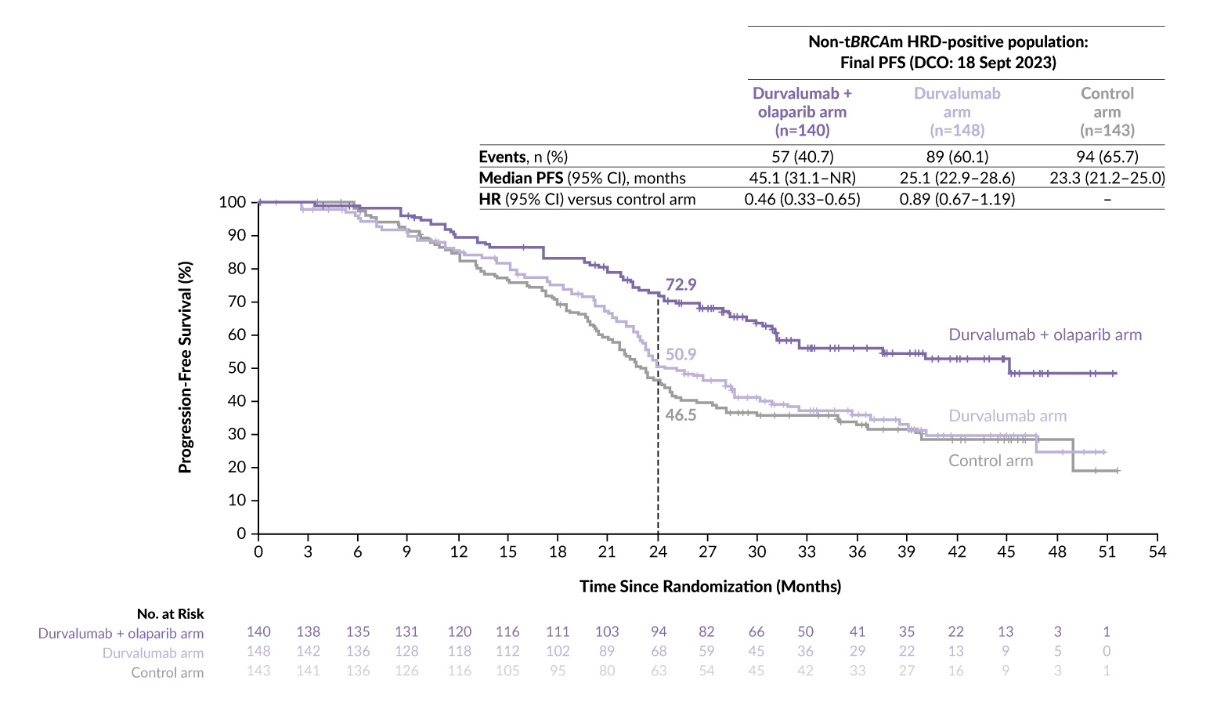
The final PFS analysis confirmed results from the primary analysis.6 In the HRD-positive subgroup, median PFS was 45.1 months in durvalumab plus olaparib compared with 23.3 months in the control arm (HR: 0.46 [95% CI: 0.33–0.65]), while the durvalumab-only arm achieved a median PFS of 25.1 months (HR: 0.89 [95% CI: 0.67–1.19]) (Figure 1).6 In the non-BRCA-mutated ITT population, median PFS was 25.1 months with durvalumab plus olaparib versus 19.3 months with control (HR: 0.61 [95% CI: 0.51– 0.73]) and 20.6 months with durvalumab alone (HR: 0.87 [95% CI: 0.77–1.03]; p=0.11).
No statistically significant benefit was observed in the overall survival (OS) analysis.6 In the HRD-positive population, at an interim analysis with 20.6% data maturity, median OS was not reached in either treatment arm, with 24-month OS rates of 96.4% with durvalumab plus olaparib versus 88.6% with control (HR: 0.84 [95% CI: 0.51–1.37]). Similarly, median OS was not reached in the durvalumab arm, with 24-month OS rates of 91.7% versus 88.6% in the control arm (HR: 0.69 [95% CI: 0.41–1.15]). Results remained consistent in the final OS analysis at 36% data maturity.7
In the ITT population, the interim OS analysis at 38.2% data maturity also showed no significant difference between treatment arms.6 Median OS was 48.5 months in the durvalumab plus olaparib arm versus 48.0 months in the control arm (HR: 0.95 [95% CI: 0.76–1.20]; p=0.68). In the durvalumab-only arm, the descriptive OS HR versus control was 0.92 (95% CI: 0.73–1.16), with median OS not reached versus 48.0 months and 24-month OS rates of 81.2% versus 79.8%, respectively. These findings remained unchanged in the final OS analysis at 53% data maturity.7
In summary, DUO-O demonstrated a clinically relevant PFS benefit with durvalumab plus olaparib, particularly in HRD-positive, BRCA-wild-type disease.5,6 However, due to the lack of poly(ADP-ribose) polymerase (PARP) maintenance in the control arm and the absence of an OS benefit, the specific contribution of durvalumab to the observed PFS benefit cannot be determined, limiting the trial’s impact on the standard of care.
_results_in_the_duo-o_study.jpeg)
TRUST: Radical upfront surgery fails to meet the primary endpoint of OS, but provides modest improvement in PFS
In advanced ovarian cancer, complete gross tumor resection is a key factor of improved survival and prolonged remission.8 While primary cytoreductive surgery (PCS) followed by chemotherapy has long been the standard approach, neoadjuvant chemotherapy with interval surgery is an alternative strategy in selected patients, although prior trials had methodological limitations.9–12 The optimal timing of surgery remains debated. The TRUST trial addresses this question by comparing surgical timing strategies in patients with resectable FIGO stage IIIB to IVB disease who are suitable for radical surgery.13
In this study, 796 patients were randomized in a 1:1 ratio to PCS or neoadjuvant chemotherapy followed by interval cytoreductive surgery (ICS).13 Notably, participating centers underwent accreditation, including an on-site quality assurance review, and were required to meet the ESGO-based criteria extended for TRUST, such as at least a 50% complete resection rate in upfront surgery for patients with FIGO IIIB to IVB cancers and a surgical volume of at least 36 cytoreductive surgeries annually.
The rates of complete resection in operated patients were 70% in the PCS arm and 85% in the neoadjuvant chemotherapy-ICS arm, with complete gross resection, defined as no macroscopic residual disease, achieved in 68% and 79% of patients, respectively.13 At a median follow-up of 46.8 months, PFS was significantly improved with PCS compared with neoadjuvant chemotherapy (median, 22.1 months vs 19.7 months; HR: 0.80 [95% CI: 0.66–0.96]; p=0.018). Despite PFS benefit, the trial did not meet its primary endpoint of OS at a median follow-up of 74.6 months, showing a median OS of 54.3 months with PCS and 48.3 months with neoadjuvant chemotherapy followed by ICS (HR: 0.89 [95% CI: 0.74–1.08]; p=0.24).
While cross-trial comparisons must be made cautiously, these results highlight the survival potential achievable in high-volume centers with stringent surgical quality control and the importance of surgical expertise in advanced ovarian cancer management.
Pembrolizumab plus paclitaxel, with or without bevacizumab, achieved clinical benefit in recurrent platinum-resistant ovarian cancer
In the phase III AURELIA study, the combination of bevacizumab and weekly paclitaxel demonstrated the greatest efficacy among chemotherapy regimens evaluated in platinum-resistant recurrent ovarian cancer.14,15 The ENGOT-ov65/KEYNOTE-B96 trial was designed to further evaluate whether adding immune checkpoint inhibition to metronomic chemotherapy could improve antitumor activity in this challenging patient population.16 In this phase III study, 643 patients with previously treated, histologically confirmed epithelial ovarian, fallopian tube or primary peritoneal carcinoma were randomized 1:1 to receive pembrolizumab or placebo; all patients received weekly paclitaxel, with or without bevacizumab. Approximately 72% of patients had tumors with a programmed death-ligand 1 (PD-L1) combined positive score (CPS) of ≥1.
Results showed that pembrolizumab significantly improved PFS in patients with PD-L1-positive tumors.16 At a median follow-up of 15.6 months, the median PFS was 8.3 months with pembrolizumab versus 7.2 months with placebo (HR: 0.72 [95% CI: 0.58–0.89]; p=0.0014). The addition of pembrolizumab also improved OS in the PD-L1 CPS≥1 group, with a median OS of 18.2 months compared with 14.0 months with placebo (HR: 0.76 [95% CI: 0.61–0.94]; p=0.0053). In the ITT population, median PFS was prolonged for approximately two months with pembrolizumab (8.3 months vs 6.4 months; HR: 0.70 [95% CI: 0.58–0.84]; p<0.0001).
The final analysis, presented at the 2026 ESGO Congress and subsequently published in The Lancet, confirmed durable clinical benefit.17,18 After a median follow-up of 32.7 months, median PFS in the ITT population remained 8.3 months with pembrolizumab versus 6.4 months with placebo (HR: 0.73 [95% CI: 0.62–0.87]), while median OS was 17.7 months versus 14.0 months (HR: 0.82 [95% CI: 0.69–0.97]; p=0.0115). In patients with CPS ≥1 tumors, median PFS was 8.3 months with pembrolizumab (n=234) versus 7.2 months with placebo (n=232) (HR: 0.76 [95% CI: 0.62–0.93]).17,18 Median OS was also longer with pembrolizumab, at 18.2 months compared with 14.0 months with placebo (HR: 0.76 [95% CI: 0.62–0.93]).
The safety profile was consistent with the known toxicities of the individual agents.16 Grade ≥3 treatment-related adverse events (TRAEs) were frequent and occurred in 67.5% of patients receiving pembrolizumab and 55.3% of those receiving placebo; serious events were reported in 33.1% and 19.5%, respectively. The most common immune-mediated AEs included hypothyroidism, infusion-related reactions and hyperthyroidism. Treatment discontinuation rates were relatively high in both arms (35.9% and 28.0%).
Notably, KEYNOTE-B96 is the first phase III trial to demonstrate a statistically significant improvement in OS with an immune checkpoint inhibitor-based regimen in ovarian cancer, both in the CPS ≥1 and ITT populations. The addition of pembrolizumab to weekly paclitaxel, with or without bevacizumab, resulted in a modest but significant improvement in PFS and OS, particularly in patients with PD-L1-positive platinum-resistant disease.16 These findings establish immunotherapy-based combinations as a meaningful additional treatment option in this setting. However, their place in clinical practice must be considered within the evolving therapeutic landscape that includes several active targeted therapies and antibody-drug conjugates. Important questions remain regarding optimal patient selection, sequencing and resistance mechanisms. Overall, despite incremental progress, platinum-resistant ovarian cancer remains area of major unmet clinical need.
ROSELLA: Relacorilant plus nab-paclitaxel demonstrates PFS benefit in platinum-resistant ovarian cancer
After PCS, patients with advanced ovarian cancer typically receive platinum-based chemotherapy with or without bevacizumab, followed by maintenance therapy with PARP inhibitors and/or bevacizumab when appropriate.19 Despite this effective regimen, up to 70% of patients relapse within three years. In the platinum-resistant setting, treatment options remain limited and outcomes are poor, with single-agent chemotherapy such as paclitaxel providing only modest benefit and reported OS in control arms of phase III trials ranging from 8.4 to 22.2 months.20 To address this unmet need, the phase III ROSELLA trial assessed relacorilant, a first-in-class, oral selective glucocorticoid receptor antagonist, in combination with nab-paclitaxel in patients with platinum-resistant ovarian cancer.21,22 Activation of glucocorticoid receptor signaling has been associated with reduced chemotherapy sensitivity, and preclinical data suggest that relacorilant may restore responsiveness to cytotoxic agents and enhance taxane-induced apoptosis.23
The open-label ROSELLA study included patients with platinum-resistant epithelial ovarian, primary peritoneal or fallopian tube cancer who had received one to three prior lines of systemic therapy, including bevacizumab, and had progressed within six months of their last platinum dose.21 A total of 381 patients were randomized 1:1 to receive relacorilant plus nab-paclitaxel or nab-paclitaxel alone. The study population was heavily pretreated, with more than 90% of patients having received two or three prior lines of therapy, and approximately 60% were treatment-naïve in the platinum-resistant setting.
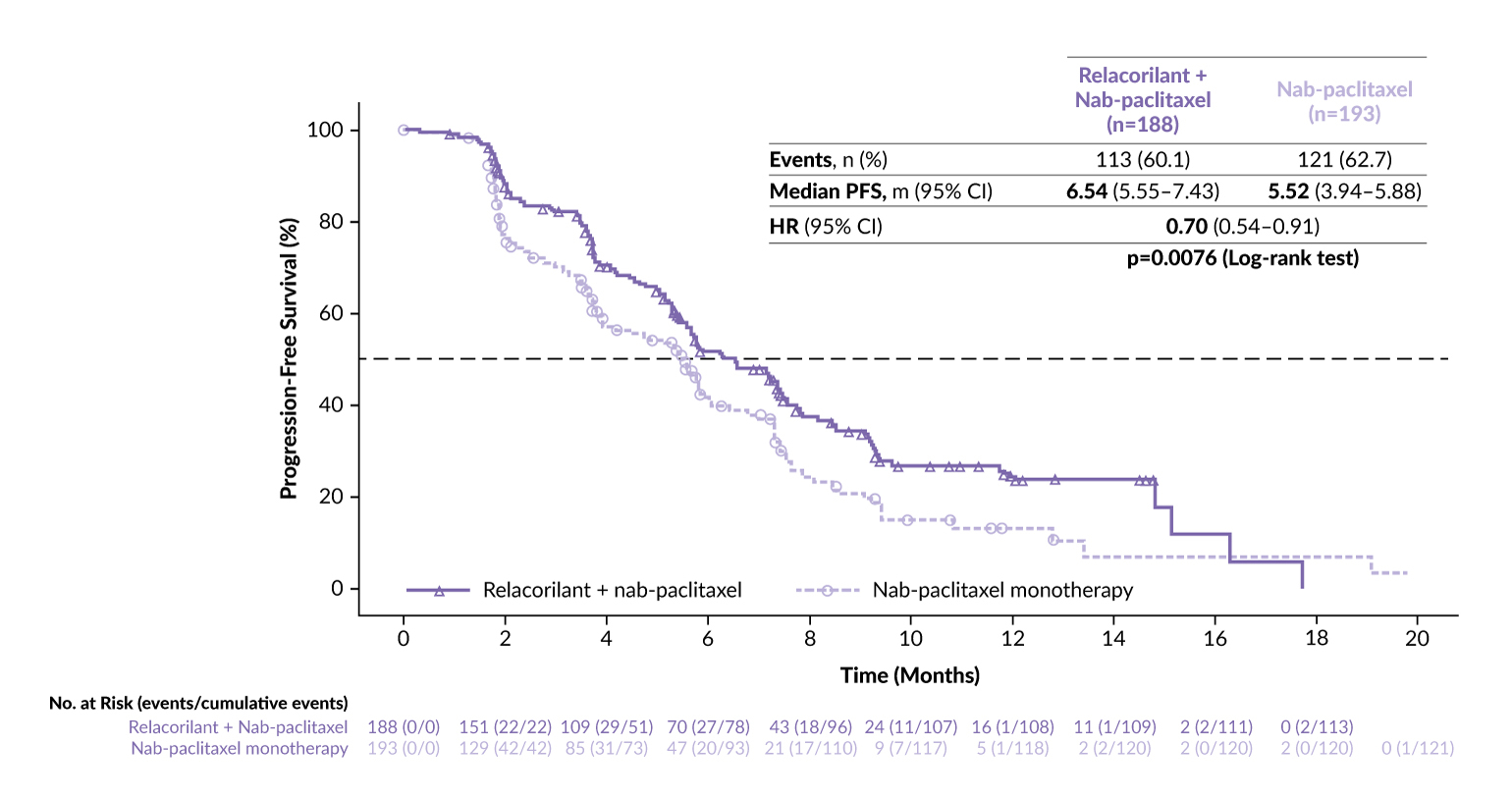
At a median follow-up of nine months, relacorilant plus nab-paclitaxel significantly prolonged PFS compared with nab-paclitaxel alone, with a median PFS of 6.54 months versus 5.52 months (HR: 0.70 [95% CI: 0.54–0.91]; p=0.0076) (Figure 2).21,22
An interim analysis at approximately 50% data maturity also showed a clinically meaningful OS benefit, with median OS of 15.97 months with relacorilant plus nab-paclitaxel compared with 11.50 months with nab-paclitaxel alone; 1-year OS rates were 60% versus 49% (HR: 0.69 [95% CI: 0.52–0.92]; nominal p=0.0121).21,22 In the final analysis conducted at a median follow-up of 24.8 months, the addition of relacorilant to nab-paclitaxel resulted in a statistically and clinically significant improvement in OS compared with nab-paclitaxel monotherapy.24 The median OS was 16.0 months versus 11.9 months, corresponding to a 35% reduction in the risk of death (HR: 0.65 [95% CI: 0.51–0.83]; p=0.0004); the 18-month OS rates were 46% and 27%. These findings represent a potential therapeutic advance for a patient population with few effective treatment options, especially for those lacking actionable molecular targets.
A prespecified subgroup analysis evaluating 234 patients (61.4% of the study population) previously treated with PARP inhibitors showed an even greater PFS benefit. Median PFS was 7.36 months with relacorilant plus nab-paclitaxel compared with 4.63 months with nab-paclitaxel alone (HR: 0.60 [95% CI: 0.42–0.85]; p=0.0035).25 A favorable trend toward improved OS was also observed, with median OS of 16.61 months versus 12.58 months (HR: 0.77 [95% CI: 0.53–1.13]; p=0.1834).
Additional subgroup analysis presented at the 2026 ASCO Annual Meeting further showed that the OS benefit of relacorilant plus nab-paclitaxel was consistent regardless of prior taxane exposure, including among patients who had received a taxane as their most recent prior therapy and those without recent taxane exposure, as well as across taxane-free interval subgroups (≤6 months vs >6 months).26
The combination of relacorilant plus nab-paclitaxel was generally well tolerated.21 Grade ≥3 treatment-emergent AEs occurred in 74.5% of patients receiving the combination compared with 59.5% in the nab-paclitaxel arm, most commonly hematological, while treatment discontinuations due to AEs were similar between the groups (9.0% vs 7.9%). In the PARP inhibitor-exposed subgroup, the safety profile was consistent with that observed in the overall population.25
These findings support relacorilant plus nab-paclitaxel as a promising therapeutic option for platinum-resistant ovarian cancer, including in patients previously exposed or refractory to PARP inhibitors.
_in_the_intention-to-treat_p.jpg)
Advanced endometrial cancer
RUBY: Sustained remission and long-term survival outcomes in patients with dMMR/MSI-H endometrial cancer
Dostarlimab is a programmed death-1 (PD-1) immune checkpoint inhibitor that has demonstrated clinically meaningful and durable activity across multiple treatment settings in advanced endometrial cancer. In the phase I GARNET trial, dostarlimab monotherapy produced durable antitumor responses in patients with mismatch repair-deficient (dMMR)/microsatellite instability-high (MSI-H) advanced or recurrent endometrial cancer who had progressed following platinum-based chemotherapy.27,28 Responses were less frequent in pMMR/microsatellite stable (MSS) tumors but remained clinically meaningful. In the 6-year analysis presented at the ESMO Gynaecological Cancer Congress 2026, the ORR remained high at 45.5%, with a disease control rate of 60.1%; the median OS has still not been reached.29 Conditional survival analyses further demonstrated sustained long-term outcomes, with an estimated 68.9% of patients alive at one year and at least 86.0% among those who had already survived two or three years remaining alive at six years.
The phase III ENGOT-EN6-NSGO/GOG-3031/RUBY trial further evaluated whether adding dostarlimab to standard carboplatin-paclitaxel chemotherapy could improve outcomes in patients with primary advanced or first recurrent endometrial cancer.30 In this global, randomized, double-blind, placebo-controlled study, 494 patients were randomized to receive dostarlimab or placebo in combination with six cycles of carboplatin and paclitaxel, followed by maintenance dostarlimab or placebo for up to three years.
At a median follow-up of approximately 24 months, dostarlimab plus chemotherapy demonstrated substantial improvements in progression-free survival (PFS), particularly among patients with dMMR/MSI-H tumors (23.9% of the study population).30 In this population, the estimated 24-month PFS rate was 61.4% with dostarlimab compared with 15.7% with placebo (HR: 0.28 [95% CI: 0.16–0.50]; p<0.001). The OS rate at 24 months was 83.3% in the dostarlimab group and 58.7% in the placebo group (HR: 0.30 [95% CI: 0.13–0.70]). In the overall study population, the 24-month PFS rate was 36.1% versus 18.1%, respectively (HR: 0.64 [95% CI: 0.51–0.80]; p<0.001). An overall survival benefit was also observed, with 24-month OS rates of 71.3% in the dostarlimab arm and 56.0% in the placebo arm (HR: 0.64 [95% CI: 0.46–0.87]).
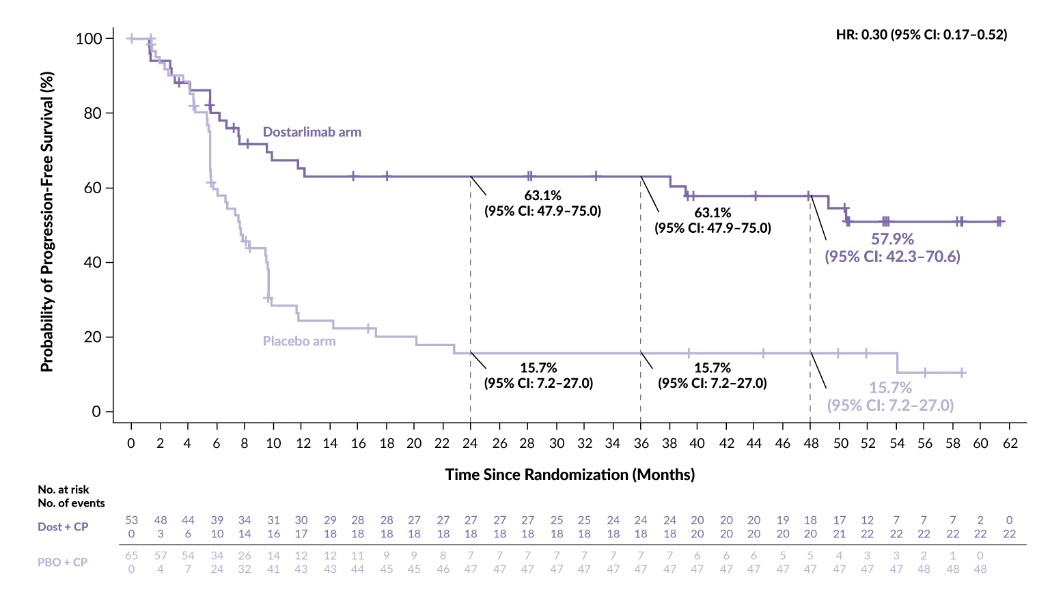
The updated 48-month analysis confirmed durable outcomes that continued to deepen over time in the dMMR/MSI-H population.31,32 After a median follow-up of 55.6 months, dostarlimab reduced the risk of disease progression or death by 70% compared with placebo (HR: 0.30 [95% CI: 0.17–0.52]) (Figure 3). Median PFS remained unreached with dostarlimab, compared with 7.7 months in the placebo arm, and the estimated 4-year PFS rates were 57.9% and 15.7%, respectively. OS also continued to improve, with a 66% reduction in the risk of death (HR: 0.34 [95% CI: 0.19–0.63]); median OS remained unreached in the dostarlimab arm versus 32.8 months with placebo and the estimated 4-year OS rates were 72.8% and 40.3%, respectively.
_microsatellite_ins.jpeg)
Conditional survival analyses further supported the durability of benefit with dostarlimab, showing that patients who were alive and progression-free at one year had an 88.6% probability of remaining alive and progression-free at four years, while those alive at one year had an 84.0% probability of remaining alive at four years.31,32
AtTEnd/ENGOT-EN7: Atezolizumab in combination with paclitaxel and carboplatin in women with advanced or recurrent endometrial cancer
The combination of carboplatin and paclitaxel has long been the standard first-line for patients with advanced or recurrent endometrial cancer.33 The rationale for combining immune checkpoint inhibition with chemotherapy, such as in the AtTEnd/ENGOT-EN7 trial, was supported by the durable activity of immunotherapy in tumors with high mutational burden, particularly dMMR or microsatellite instability-high (MSI-H) disease, together with potentially immunomodulatory effects of chemotherapy.27,34,35 Subsequent phase III trials evaluating pembrolizumab, dostarlimab and durvalumab have since established chemoimmunotherapy as a new standard of care in this setting.30,36,37
The AtTEnd/ENGOT-EN7 trial recruited 549 patients with newly diagnosed FIGO stage III–IV or recurrent endometrial carcinoma not previously treated with systemic therapy for recurrence and randomized them 2:1 to atezolizumab plus carboplatin and paclitaxel or placebo plus chemotherapy, followed by maintenance atezolizumab or placebo.36 The primary analysis demonstrated a significant improvement in PFS with atezolizumab versus placebo (median, 10.1 months vs 8.9 months; HR: 0.74 [95% CI: 0.61–0.91]; p=0.022), with a pronounced benefit in dMMR tumors (not estimable vs 6.9 months; HR: 0.36 [95% CI: 0.23–0.57]; p=0.0005).
The final OS analysis demonstrated a clinically relevant OS benefit in the dMMR subgroup, with median not reached in the atezolizumab arm compared with 31.8 months in the placebo arm (HR: 0.49 [95% CI: 0.28–0.83]; p=0.0038).38 In contrast, no significant difference in OS was observed among patients with pMMR disease (30.0 months vs 30.2 months; HR: 1.02 [95% CI: 0.78–1.34]; p=0.6644) or in the overall population (median 36.0 months vs 30.5 months; HR: 0.87 [95% CI: 0.69–1.10]; p=0.0824).
An exploratory multi-omic analysis integrating whole-exome sequencing, RNA sequencing and multiplex immunofluorescence provided further biological insights.39 Among the 234 tumor samples with available whole-exome sequencing data, POLE mutations were rare (n=1) and a dual dMMR and BRCA1/2-mutated profile was identified in 14 cases. Among 110 dMMR tumors, MSH3 mutations were detected in 26.4%, while co-alterations in APC and CTNNB1 within the WNT signaling pathway were detected in 20.9% of samples and were associated with shorter PFS (HR: 1.91 [95% CI: 1.10–3.33]; p=0.0201). Whole-exome sequencing-derived aneuploidy was identified in 9.1% of dMMR tumors and appeared to predict reduced benefit from atezolizumab, with considerably poorer outcomes observed in the high-aneuploidy group compared with low-aneuploidy tumors (HR PFS: 3.60 vs 0.28; HR OS: 1.36 vs 0.40). High aneuploidy was also associated with reduced immune infiltration, lower CD4-positive T-cell density and increased M2-like macrophage presence, suggesting a less immunologically responsive tumor microenvironment.
Overall, these results support immune checkpoint inhibition as a key therapeutic strategy in dMMR endometrial cancer and reinforce mismatch repair status as a predictive biomarker. If validated, additional genomic features such as aneuploidy score, MSH3 mutations and WNT pathway alterations may improve patient selection and help identify dMMR tumors less likely to benefit from immunotherapy-based approaches.
NRG-GY018: Long-term OS benefit with pembrolizumab plus chemotherapy in advanced/recurrent endometrial cancer
Pembrolizumab, another programmed death-1 (PD-1) immune checkpoint inhibitor, has also demonstrated significant clinical benefit when combined with first-line chemotherapy for advanced or recurrent endometrial cancer. In the phase III NRG-GY018 trial, 816 patients with newly diagnosed stage III–IV or recurrent endometrial cancer underwent 1:1 randomization to receive pembrolizumab or placebo in combination with paclitaxel and carboplatin for six cycles, followed by maintenance pembrolizumab or placebo for up to 14 additional cycles.40 Patients were stratified according to MMR status and the primary endpoint was PFS.
At the primary analysis, the addition of pembrolizumab significantly improved PFS in both molecular subgroups.40 Among patients with dMMR tumors, the estimated 12-month PFS rate was 74% with pembrolizumab compared with 38% with placebo and median PFS was not reached versus 7.6 months (HR: 0.30 [95% CI: 0.19–0.48]; p<0.001). In patients with pMMR tumors, median PFS was prolonged from 8.7 months to 13.1 months (HR: 0.54 [95% CI: 0.41–0.71]; p<0.001). Exploratory blinded independent central review confirmed the PFS benefit in both the dMMR (HR: 0.45 [95% CI: 0.27–0.73]) and pMMR (HR: 0.64 [95% CI: 0.49–0.85]) populations.41
The updated OS analysis presented at the ASCO Annual Meeting 2026 demonstrated durable long-term benefit, particularly in the dMMR population.42 At the 48-month landmark analysis, 78.6% of patients with dMMR tumors treated with pembrolizumab were alive compared with 60.4% of those receiving placebo (HR: 0.56 [95% CI: 0.34–0.92]; p=0.0124); median OS was not reached in either treatment arm. This survival advantage was maintained despite more than half of patients in the placebo arm subsequently receiving immune checkpoint inhibitors. In the pMMR cohort, median OS was 44.4 months with pembrolizumab versus 35.1 months with placebo, with 48-month OS rates of 46.7% versus 39.5% (HR: 0.86 [95% CI: 0.69–1.08]). Importantly, nearly 60% of patients in the placebo arm received subsequent immune checkpoint inhibitor therapy, most commonly pembrolizumab plus lenvatinib, yet the magnitude of the OS benefit remained consistent.
Study 309/KEYNOTE-775: Lenvatinib plus pembrolizumab demonstrates sustained long-term benefit in previously treated advanced endometrial cancer
The phase III Study 309/KEYNOTE-775 trial established the combination of lenvatinib, a multitargeted tyrosine kinase inhibitor, and pembrolizumab as a new standard of care for patients with advanced or recurrent endometrial cancer who progress after platinum-based chemotherapy.43–45 In the primary analysis, the combination significantly improved PFS and OS compared with chemotherapy, both in the pMMR population and among all the patients,43 particularly addressing the unmet need in patients with pMMR or microsatellite-stable disease, who constitute the majority of the endometrial cancer population.46,47
In KEYNOTE-775, 827 patients with advanced endometrial cancer who had received at least one prior platinum-based regimen underwent 1:1 randomization to receive lenvatinib plus pembrolizumab or chemotherapy of the physician’s choice (TPC).43 The study was powered to assess outcomes in both the pMMR population (n=697) and the overall cohort.
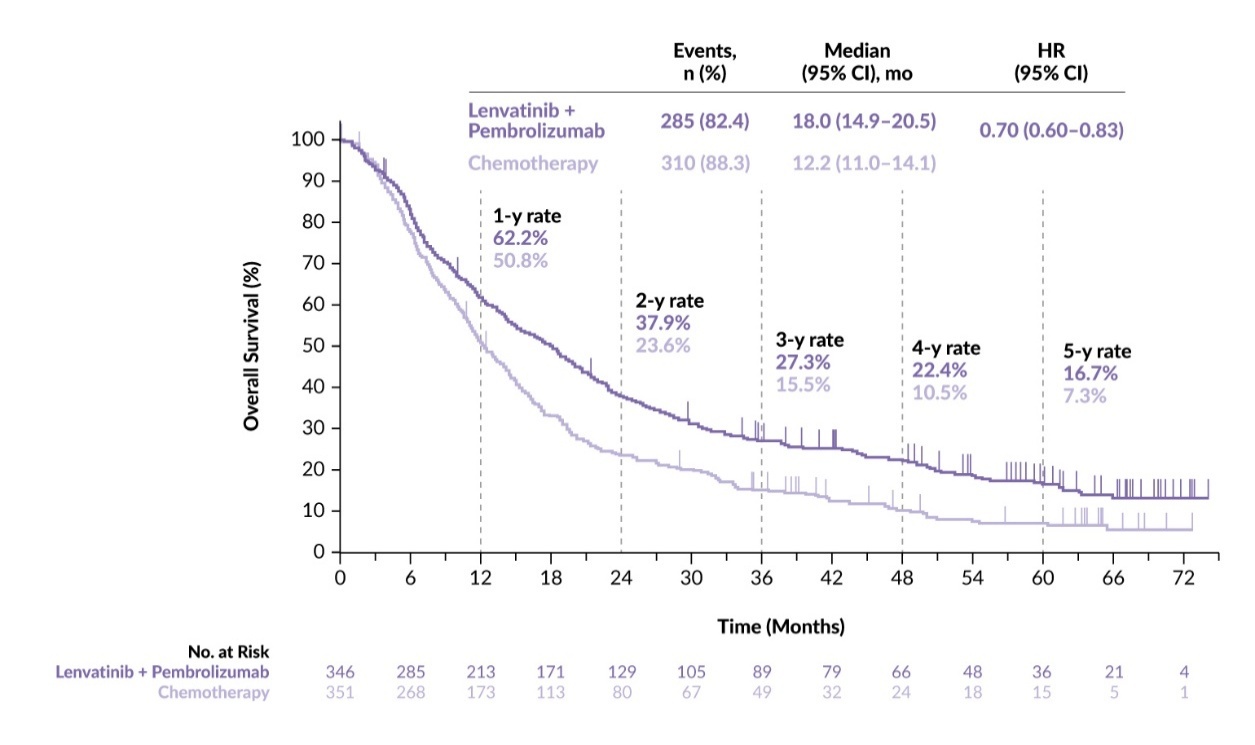
The 5-year follow-up demonstrated durable benefits of lenvatinib plus pembrolizumab, with survival curves remaining separated over time across biomarker-defined subgroups. At a median follow-up of 68.8 months, the survival benefit of lenvatinib plus pembrolizumab remained durable across biomarker subgroups.48,49 The 5-year OS rate was 16.7% with the combination versus 7.3% with TPC (HR: 0.70 [95% CI: 0.60–0.83]) in the pMMR population (Figure 4) and 36.5% versus 9.8% (HR: 0.44 [95% CI: 0.29–0.67]) in the dMMR population. Corresponding 5-year PFS rates were 6.3% versus 2.1% (HR: 0.60 [95% CI: 0.51–0.72]) and 26.4% versus 10.8% (HR: 0.39 [95% CI: 0.25–0.60]). OS benefits were maintained despite the high crossover rate and substantial use of subsequent systemic therapies in the control arm. This is particularly relevant in advanced endometrial cancer, where attrition between treatment lines is common and long-term survival has been historically rare.
_population.jpeg)
Response data further indicated antitumor activity of the combination in this setting.48,49 Lenvatinib plus pembrolizumab achieved higher response rates and deeper responses than chemotherapy across pMMR, dMMR and all-comer populations, with a meaningful proportion of patients achieving complete responses.
Regarding safety, long-term follow-up did not reveal new or unexpected toxicities.48,49 The AE profile remained consistent with the known safety characteristics of lenvatinib and pembrolizumab, and although TRAEs and discontinuations were more frequent with the combination than with chemotherapy, these were generally manageable with dose modifications and supportive care.
In summary, the long-term data from Study 309/KEYNOTE-775 confirm lenvatinib plus pembrolizumab as an effective therapy for previously treated advanced or recurrent endometrial cancer.48,49 The sustained survival benefit, durable responses and manageable safety profile observed over nearly five years of follow-up confirm the role of the combination in routine clinical practice, particularly for patients with pMMR disease who previously had limited effective options.
Cervical cancer
Camrelizumab plus famitinib prolonged PFS versus chemotherapy in first-line metastatic cervical cancer
Platinum-based chemotherapy, with or without bevacizumab and/or immune checkpoint inhibition, remains the cornerstone of first-line treatment for recurrent or metastatic cervical cancer.50 Historically, chemotherapy alone has yielded a median OS of approximately 13 to 18 months,51,52 while the addition of immunotherapy has extended survival to approximately 26 to 32 months.53,54 Despite these advances, treatment-related toxicity remains substantial and there have been efforts for effective chemotherapy-free strategies. One such approach combines camrelizumab, a PD-1-targeting monoclonal antibody, with famitinib, a multitarget tyrosine kinase inhibitor, which demonstrated encouraging antitumor activity in pretreated recurrent or metastatic cervical cancer.55
At the ESMO Congress 2025, results were presented from a randomized, multicenter phase III trial assessing camrelizumab plus famitinib versus platinum-based chemotherapy with or without bevacizumab.56 The study recruited 443 patients with recurrent or metastatic cervical cancer who received camrelizumab plus famitinib or the investigator’s choice of chemotherapy (paclitaxel plus cisplatin or carboplatin, with or without bevacizumab). Most patients had PD-L1-positive tumors (93%) and metastatic disease (97%, FIGO stage IVB).
After a median follow-up of 19.3 months, the combination of camrelizumab plus famitinib demonstrated superior efficacy compared with chemotherapy.56 PFS was significantly prolonged with camrelizumab plus famitinib (11.1 months vs 7.5 months; HR: 0.68 [95% CI: 0.53–0.86]; p=0.0007) and a clinically meaningful OS benefit was also observed (34.4 months vs 23.4 months; HR: 0.65 [95% CI: 0.49–0.86]; p=0.0012). Furthermore, the ORR was 52.3% with camrelizumab plus famitinib, including a CR rate of 10.9%, compared with 46.6% and 8.5%, respectively, in the chemotherapy arm.
Treatment-related toxicity was more frequent with the experimental therapy.56 Grade ≥3 TRAEs occurred in 87% of patients receiving camrelizumab plus famitinib compared with 67% of patients receiving chemotherapy, leading to treatment discontinuation in 14% and 7% of patients, respectively.
Although the study demonstrated clinically meaningful antitumor activity of camrelizumab plus famitinib in the first-line setting, interpretation within the modern treatment landscape requires caution. The control arm did not include immune checkpoint inhibition and only 30.9% of patients received bevacizumab, indicating that the comparator did not fully reflect the current standard of care. While the results are promising and support further development of chemotherapy-free strategies, the positioning of this regimen relative to current immunotherapy-based standards remains to be clarified.
Conclusions
The discussed studies show an expanding therapeutic landscape across major gynecologic malignancies and highlight the growing role of biomarker-driven and immunotherapy-based strategies. In ovarian cancer, combinations incorporating PARP inhibition, immune checkpoint blockade and optimized surgical management continue to improve progression-free outcomes, although OS benefits remain inconsistent and unmet needs persist in platinum-resistant disease. Emerging therapies such as relacorilant-based combinations and chemoimmunotherapy provide clinically relevant advances for heavily pretreated populations. In endometrial cancer, immune checkpoint inhibition remains important, particularly in dMMR disease, while long-term data confirm the durable benefit of lenvatinib plus pembrolizumab across biomarker subgroups. In cervical cancer, novel chemotherapy-free or immunotherapy-based combinations demonstrate promising efficacy, although their integration within modern standards requires further clarification. Taken together, these findings highlight continued progress alongside persistent challenges and emphasize the importance of patient selection, biomarker integration and rational treatment sequencing to further improve long-term outcomes.
Conflict of interest
Marcus Vetter received honoraria for consultancy from GSK, Roche, Novartis, Exact Sciences, Pfizer, Stemline, AbbVie and ASC Oncology. These funding entities did not play a role in the development of the manuscript and did not influence its content in any way. Rosanna Zanetti declared that the manuscript was written in the absence of any commercial or financial relationships that could be construed as a potential conflict of interest.
Funding
The authors declared that no financial support was received from any organization for the submitted work.
Author contributions
The authors created and approved the final manuscript.